
When we first wrote about analytics enablement in 2019, marketing analytics was resisting in-housing in a way that media buying was not. Three barriers explained why: talent, trust and technology. Seven years on, one of those has changed materially and the other two have not. That asymmetry, rather than any single conclusion, is what should shape the decision.
What changed: the modeling layer
Marketing Mix Modeling code is now available at no cost. Google's Meridian and Meta's Robyn are published free by the platforms themselves, one Bayesian and one built on ridge regression, and the open statistical community maintains PyMC-Marketing in Python alongside them.
These are not demonstration projects. Between them they offer geo-level and national modeling, lift-test calibration, out-of-sample forecasting and budget optimization. Meridian now ships a no-code scenario planning interface in open beta, so a trained model can be turned into an interactive budget report without writing code.
This is a real change and it widens the option set. An organization that could not have contemplated building a marketing mix model in 2019, on cost grounds alone, can now begin. Assessed on license cost alone, the conclusion looks obvious. But license cost was never the largest component of what a measurement program costs, and the two barriers that did not fall are the ones that determine whether the program produces decisions.
Three positions, not a ladder
We have historically described three engagement models: DIFM, DIWM and DIY. In plainer terms these are fully managed, collaborative and fully in-house, and they are better understood as points on a spectrum than as rungs on a ladder. The useful question is not which is most advanced, but which matches an organization's data maturity, internal capability and political context at a given moment.
| Position | What it is | What it asks of you |
|---|---|---|
| Fully managed (DIFM) | Modeling, optimization and interpretation delivered end to end, with basic training. | Little internal capability, but real engagement. The value depends on stakeholders trusting a third party’s numbers, and independence is the reason they often do. |
| Collaborative (DIWM) | Modeling conducted jointly, with training across the end-to-end process. | Dedicated internal resource and the appetite to learn. Suits organizations that need to defend the numbers internally rather than cite them. |
| Fully in-house (DIY) | Client-led modeling with external support, typically licensing a modeling and optimization platform. | A data engineer, an analyst who can interrogate statistical assumptions, and an accepted governance process. The newly accessible option, and the one where the failure mode is least visible. |
None of these is a destination. Organizations move between them as teams change, budgets shift, or a reorganization puts measurement under a different function. A useful analogy is chartering a boat: the same vessel can be taken bare-boat or with a full crew, and the right choice depends on the conditions and who is aboard, not on which option is more sophisticated.
What became free, precisely
It is worth being exact about what the free frameworks estimate, because the boundary is easy to miss. They model short-term marketing response, including carryover through adstock and saturation, alongside trend and seasonal controls. Both Meridian and PyMC aim to incorporate a dynamic baseline to control for long-term variation – either through a simplistic knot-based approach (Meridian) or a more advanced Gaussian process (PyMC). However, it is worth noting two drawbacks here:
- Firstly, the Meridian approach cannot handle both flexible trend extraction and regression parameter heterogeneity for every cross section: dynamic base estimation is highly aggregated. PyMC is more flexible, since a user can take the built-in Gaussian process or code an alternative such as a random walk, though the large parameter count slows Hierarchical Bayesian simulation considerably.
- Secondly, both are simply time-series processes designed to capture unobserved slow-moving variation and independent of marketing. This may help improve model fit and short-term parameter estimation but fails to capture the true long-term (brand-building) effects of marketing. To do so requires a meaningful economic model of how marketing drives the baseline. In our own work that means integrating brand metrics into the mix model, through Hierarchical Bayesian Unobserved Components (UCM) panel models for the short term combined with a cointegrated VAR linking brand metrics to long-term base sales.
The distinction is commercial, not just technical. Adstock describes how a media effect decays within the modeled window. It does not measure brand-building and treating it as though it does produces what we have elsewhere called spurious claims of long-term effects. A team running a free framework competently will get a defensible short-term model. But without a clear definition of a brand-building effect, or a coherent framework for estimating one, the consequence is a systematic under-valuation of brand investment and over-allocation toward channels that harvest existing demand.
This is a matter of scope rather than a reason to avoid the in-house route. It does mean the scope should be understood before the first model informs a budget.
Separating those horizons is what our own platform, Marketscience Studio, is built for, so we would say that. It holds regardless of who is running it.
What did not change: talent and trust
In 2019 the constraint was finding someone who could build a marketing mix model. Econometric training was scarce and the people who had it were being hired by large technology firms.
The constraint now is finding someone who can tell when a model is wrong. That is a different skill and a rarer one. Standard model-checking skills would cover issues such as confounding seasonal and marketing drivers, multicollinearity problems when channels are planned and move together and model residual patterns driven by heteroscedasticity and autocorrelation. Each of these is observable and, if handled by a competent modeler, will return a clean, plausible, well-presented result. However, even then, this is no guarantee of model adequacy. The real skill in any MMM is recognizing and handling endogeneity bias: the selection bias problem arising when the ‘treatment’ mechanism is determined by the (potential) outcome – such as targeted advertising to consumer groups who ‘would have bought anyway’. This is known as the ‘identification’ problem, is wholly unobservable and destroys any causal interpretation of the MMM outputs, together with budget allocation results.
This is certainly recognized by Google and the Meridian platform, where it is argued that goodness-of-fit metrics provide no reliable evidence of causal structure: a model can track history closely and still be wrong about what caused what, and no diagnostic in the software will raise its hand. Hence the use of natural search to control for the endogeneity of paid search and geo-testing as a form of ‘controlled’ experiment. It also underpins the growing use of external experimental results as ‘priors’: an identification strategy that sits naturally in the Bayesian set up of both Meridian and PyMC. Even there, end-users must guard against priors that determine the answer rather than inform it.
The bottom line here is that many competing identification strategies are open to us and all necessarily rest on assumptions the analyst has to choose and defend.
The practical consequence: free code converts a hiring problem into a judgment problem. Judgment is the expensive part, and it was never what the license fee was paying for.
Trust has not moved either. Where analytics is used to evaluate and optimize significant investment, internal teams face skepticism comparable to external vendors. Being on the payroll does not confer neutrality when the analysis grades a colleague's budget.
One dimension has been added. Several of the most widely adopted free frameworks are published by companies that sell the media those frameworks measure. This is not an accusation of bad faith, and the code is public precisely so that it can be inspected. But it is a structural consideration, and it is the kind of thing a Finance Director asks about. Vendor neutrality is easier to demonstrate when the party doing the measurement has no stake in the channels being measured.
Estimation is not a measurement program
The distinction that matters most in this decision is between a model and a program. The free frameworks estimate response. They do not supply the components that surround estimation and usually determine whether results get used:
- A data layer, and the ongoing work of keeping channel taxonomies stable as media plans change.
- Cost and margin data joined to marketing data at usable granularity, which almost always lives in finance systems rather than marketing ones.
- A refresh cadence fast enough to inform decisions rather than explain them afterwards.
- Simulation and optimization that planners can actually operate, and reporting that non-technical stakeholders will trust.
- Governance: who agrees the specification, who may challenge a result, and what happens when the model disagrees with a stakeholder.
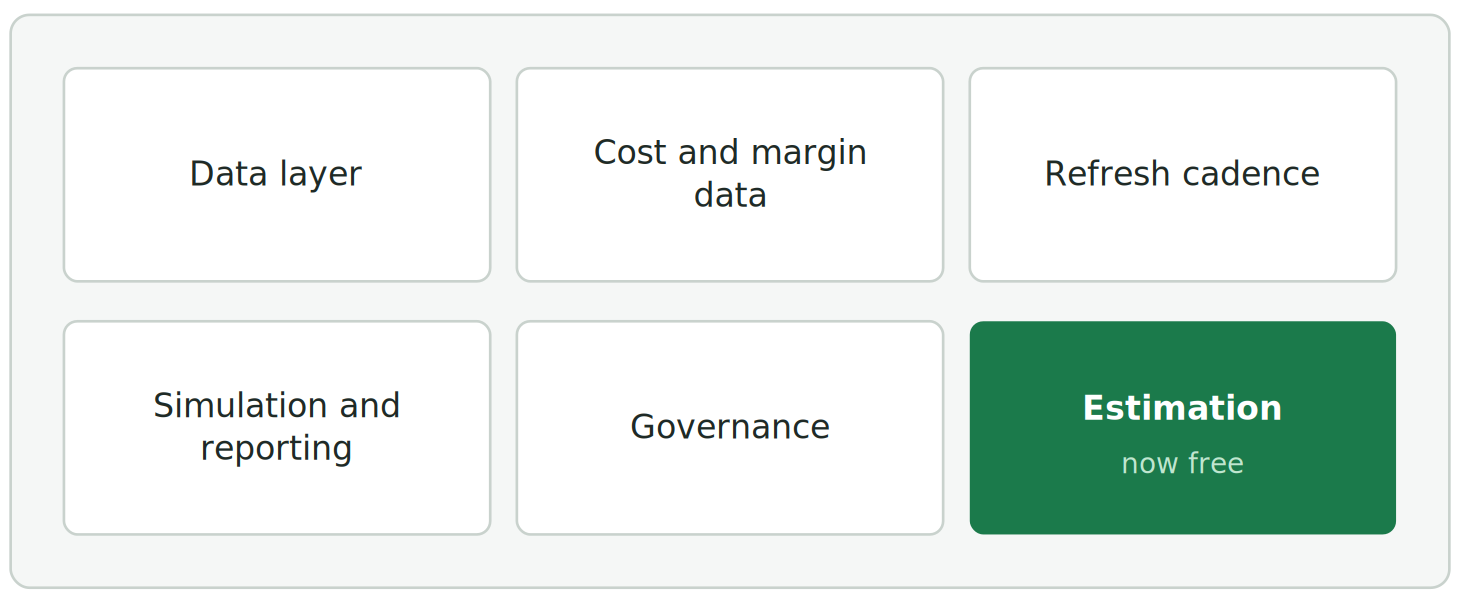
Every organization running Marketing Mix Modeling has these components. The only question is whether they were built internally, licensed as software, or delivered as a service. That is the distinction worth drawing: the estimator is the part whose price fell, not the part that became easy.
There is also a continuity risk that free software concentrates rather than relieves. Where the capability lives in one person's understanding of one codebase, their departure can end the program. The code remains. The ability to defend it does not. These are questions about the operating model around measurement, and relocating the work in-house does not by itself resolve them.
Practical guidance on choosing
Most Marketing Mix Modeling decisions start with which tool to recommend, but the tool is rarely the binding constraint. Estimation routines differ in real ways, but two organizations running the same software still routinely produce work of very different quality, because specification, data and interpretation differ too. A more useful sequence:
- Start with the data foundation. If cost and margin data is not joined to marketing data at usable granularity, address that before selecting anything. No marketing analytics tool compensates for a missing foundation, and every one of them will produce confident output regardless.
- Assess capability honestly, not aspirationally. The relevant question is not whether someone can run the code, but whether anyone can identify a misspecified model and say so. If the answer is nobody, the in-house route carries a risk that will not surface until a decision has already been made on it.
- Be clear which horizon you need. If the decision at stake is quarterly performance allocation, short-term estimation may be sufficient. If it concerns the balance between brand and performance investment, it is not, and no amount of data engineering closes that gap.
- Consider who needs to believe the result. If measurement is internally contested, or the output will move very large budgets, independence has value that no software license provides. If the audience is the marketing team itself, that consideration weighs less.
Frequently Asked Questions (FAQs)
Is free Marketing Mix Modeling (MMM) software good enough for enterprise use?
The statistical foundations are sound and the feature sets now include budget optimization and lift-test calibration. The gaps are elsewhere: the surrounding program of data preparation, cost and margin data, refresh cadence and governance, and the separation of short-term response from long-term brand building. These frameworks model a dynamic baseline, but independently of marketing, so long-term movement is absorbed into the baseline rather than attributed to brand building. Organizations that treat the framework as the program tend to struggle. Those that treat it as one component do well.
What skills do you need in-house to run Marketing Mix Modeling?
At minimum a data engineer who can maintain the pipeline, and an analyst who understands Bayesian estimation well enough to interrogate priors, adstock and saturation assumptions rather than accept defaults. The second is the scarcer of the two. Marketing context matters as much as statistical training, because most serious errors take the form of implausible results that a domain expert would question and a purely technical reviewer would not.
Should we use a framework published by an advertising platform?
They are capable, free, and open to inspection. The consideration is governance rather than technical quality: the publisher sells media that the model evaluates. Many organizations use these frameworks and validate the outputs independently, which is a reasonable position. Adopting one with no independent check is harder to defend to finance.
Does bringing MMM in-house save money?
On license cost, yes, and it can be substantial. On total cost it depends on whether you already employ the data engineering and statistical capability, and on what that capacity would otherwise be doing. The honest framing is that in-housing changes what you spend on more than how much, moving expenditure from software and services to salaries and internal time.