
Abstract
Generative AI is eroding the visibility that marketing measurement has depended on for two decades.
The behavioral signals underpinning attribution were already under pressure. AI adds to that pressure by influencing decisions earlier in the journey, often without leaving a trace that conventional tools can capture.
At the same time, brand visibility within AI systems is increasingly determined by signals that cannot be bought in the traditional sense.
This article examines what these parallel shifts mean for CMOs allocating investment, and for the measurement frameworks used to justify those decisions.
Introduction
Marketing measurement depends on visibility.
For two decades, that visibility came from a relatively stable structure: consumers searched, clicked, and converted. Each step left a signal that could be tracked, attributed, and optimized. The architecture of digital marketing – keyword bidding, click-through rates, and multi-touch attribution (MTA) rests on that foundation.
That foundation had already begun to erode. Cookie deprecation, privacy regulation, and walled gardens had each degraded the behavioral signals that attribution depends on. Generative AI is not the origin of this problem, it is an acceleration of it, and in one respect a structural amplification: influence that occurs inside an AI interface leaves no trackable signal at all, by design.
AI is now intermediating the consumer journey at the discovery and evaluation stages, answering questions, synthesizing options, and in some cases completing tasks on behalf of users. The click that measurement depended on is happening later, happening less, or not happening at all.
This creates two distinct but related challenges.
The first is a measurement problem: influence that occurs upstream of the click is increasingly invisible to the tools most organizations rely on today.
The second is a strategic visibility problem: whether a brand appears in AI-generated responses is now governed by signals such as third-party sentiment, structured data quality, and attribute consistency that are harder to buy and harder to track than traditional media exposure.
The previous model gave marketers both visibility into performance and a degree of control over how visibility was acquired. AI is eroding both at once.
I. How AI Is Reducing Measurement Visibility
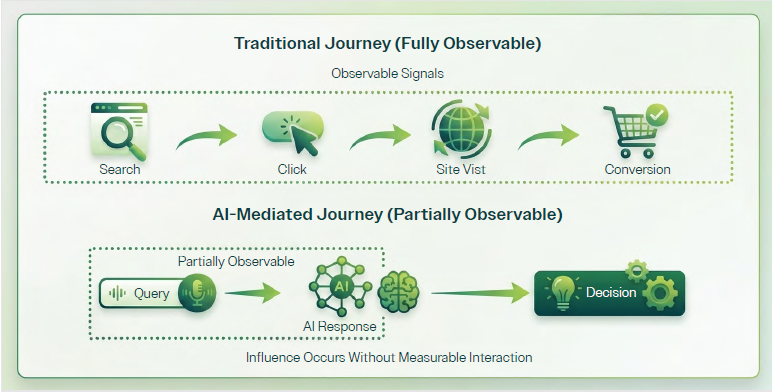
The zero-click trend predates generative AI, but its acceleration has materially changed the scale and nature of the measurement challenge.
A 2024 study by SparkToro and Datos estimated that roughly 60% of Google searches now end without a click, as users extract answers directly from search result pages or AI Overviews.[1] At the same time, survey data from Salesforce indicates that a growing share of consumers are using generative AI tools for product research.[2] While individual figures should be treated directionally rather than precisely, the combined signal is clear: a larger proportion of consumer decision-making is taking place within environments that were not designed to produce trackable interactions.
The implication is not simply that click volumes are declining, it is a breakdown in the link between exposure and observable behavior.
An AI-generated response that consistently surfaces a brand in relevant queries is shaping awareness and consideration in a meaningful way. But it does so without generating the signals (e.g. clicks, cookies, impressions) that conventional measurement frameworks depend on. Conversely, a loss of visibility in those responses can erode demand in ways that may only become apparent in downstream performance metrics weeks or months later.
For CMOs, this creates a resource allocation challenge as much as a measurement one. Upper-funnel investment has always been difficult to justify in environments that prioritize short-term, directly attributable returns. AI intensifies that tension by compressing or bypassing the discovery phase that awareness activity was designed to influence, while simultaneously increasing the importance of brand strength over the longer term.
"The consumer journey may not simply be shorter or longer, it appears to be changing shape. Fewer touchpoints, potentially, but each carrying more weight."
The commercial structure of AI search introduces an additional layer of complexity. Advertising is increasingly being integrated directly into AI-generated responses. Unlike traditional search formats, where paid placements are visually distinct, AI-integrated advertising is embedded within the answer itself. The distinction between paid and organic influence becomes less visible to users, raising longer-term questions about how trust and effectiveness will evolve as commercialization deepens.[3][4]
There is also a structural shift in audience economics that planning frameworks have not yet fully absorbed. Paid AI tiers, typically adopted by higher-income and higher-engagement users, tend to be ad-free.[5] Free tiers, where advertising inventory is concentrated, skew toward younger and more price-sensitive audiences.[6] As adoption grows, this creates a dynamic in which the most commercially valuable users are now less exposed to advertising.
"AI platforms face a monetization paradox: their most commercially valuable users are paying specifically to avoid their ads."
For marketers, this is not simply a media planning nuance. It suggests that AI is reshaping both how influence occurs and who is exposed to it, introducing a layer of structural bias into the market that did not exist in the same way in traditional search.
AI is not just changing how demand is captured, it is beginning to reshape the composition of demand itself.
II. How Brand Visibility Within AI Systems Is Earned, Not Bought
The second visibility problem is less about measurement and more about the determinants of visibility itself.
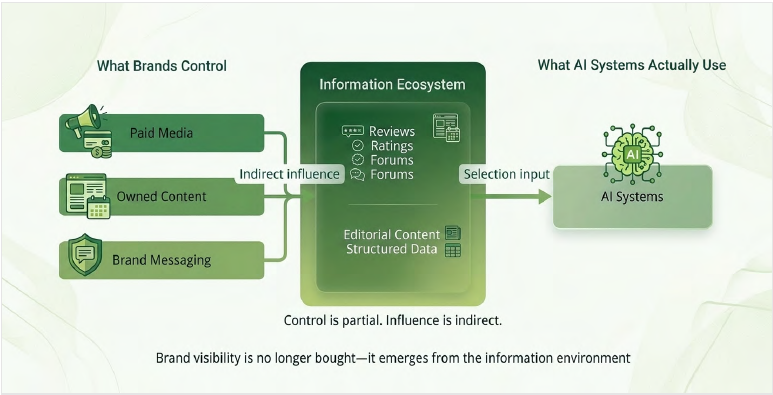
AI models draw heavily on third-party information including reviews, forums, editorial content, and other publicly available sources, rather than brand-owned messaging. As a result, what others say about a brand carries more weight than what the brand says about itself.[7]
This shifts brand visibility from something that can be largely purchased through media to something that is now earned through the broader information environment.
Consistency of brand attributes across third-party sources (e.g. reliability, innovation, value) now has a more direct effect on whether a brand is surfaced in AI-generated responses. This moves brand from a long-term perception driver to a more immediate input into how demand is mediated.
In that sense, AI reinforces rather than undermines a core principle of marketing science: that brand equity generates compounding returns over time. What is changing is the mechanism through which those returns are realized. AI systems make the link between brand strength and commercial outcomes more direct, and in some cases more immediate. Marketscience's research has shown how brand attitudes and long-term sales move together as a cointegrated system, a relationship that AI-mediated discovery makes more, not less, consequential.[8][9]
This dynamic becomes explicit as AI moves from recommendation to action, with Agentic AI making this shift more concrete. AI agents capable of completing tasks on behalf of users, such as comparing products, booking services, or executing transactions, select between brands partly on the basis of structured data signals: pricing accuracy, availability, ratings, and data quality.[10] As these systems mature, these functional criteria may carry more weight in certain categories than the emotional and aesthetic dimensions of brand communication that traditional advertising has historically optimized for. How long-term advertising effects accumulate and are synthesized in this context is also an open methodological question, one Marketscience has examined in the context of conventional Marketing Mix Modeling frameworks.[11]
This does not make brand advertising irrelevant. It changes what is required. Brand communication designed for human audiences remains critical for building the attribute signals and preference that AI models will ultimately synthesize. But content designed for machine readability, meaning clear, structured, and authoritative content, is becoming an equally necessary investment. In that sense, marketing is gradually operating across two parallel layers: one human-facing, one machine-facing. As the volume of AI-generated content increases, genuinely original and authoritative material may become a stronger signal, both to human audiences and to the systems that rank and recommend it.
In this context, machine-readable content is not a technical consideration. It is part of the commercial infrastructure that determines whether a brand is included in the consideration set at all.
For CMOs, this creates a structural shift in how brand investment needs to be deployed.
First, sustained investment is needed in brand communication that builds the attribute signals such as trust, quality, and value that AI systems will later synthesize.
Second, investment is required in content and data infrastructure that ensures those signals are legible and accessible to machines.
These are not competing priorities. They are complementary components of the same visibility problem, operating at different layers of the same underlying structure.
This creates a second-order measurement challenge.
It is not only that influence is less visible. It is that the drivers of influence including reputation, attribute ownership, and data quality, are themselves less directly observable within traditional measurement frameworks.
Measurement therefore needs to adapt not only to the loss of signals, but also to the changing nature of what drives outcomes.
III. From Tracking Behavior to Inferring Impact
Taken together, these shifts break the assumptions that traditional measurement depends on.
If visibility declines and the drivers of influence change, measurement cannot remain anchored to observed behavior.
In practical terms, what can be measured directly is no longer a reliable proxy for what is driving outcomes.
The response to these visibility shifts is not a single new tool. It is a shift in measurement philosophy, from tracking behavior to inferring impact at a system level.
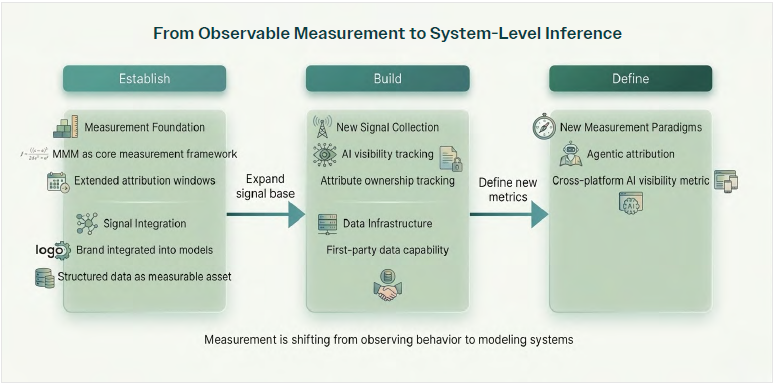
Act Now: Establish a Measurement Framework That Does Not Depend on Visibility
Organizations need a measurement approach that is structurally independent of user-level tracking.
In practice, this means elevating Marketing Mix Modeling (MMM) to a central role. MMM was gaining renewed relevance as cookie deprecation and walled gardens degraded the inputs that MTA depends on.[12] AI adds further weight to that case. MMM operates on aggregated data, estimating the contribution of marketing inputs to business outcomes without relying on observable user journeys. In a context where influence often occurs before the click, or without one altogether, this is not just a defensible alternative. It is the more structurally appropriate framework.
More fundamentally, this reflects a broader strength of econometric approaches, of which MMM is one application. MMM is not limited to marketing inputs; it incorporates a wide range of demand drivers, including price, promotion, distribution, and macroeconomic factors. In that sense, it is better understood as a framework for modeling demand, rather than as a marketing-specific tool. In more advanced applications, these approaches extend beyond optimizing marketing in isolation to understanding how marketing interacts with other commercial decisions, such as product configuration, channel strategy, and availability, alongside supporting capabilities like anomaly detection to identify unexpected shifts in performance.
At the same time, attribution frameworks should be repositioned within a broader measurement framework to reflect longer and less visible decision cycles. Extending attribution windows does not solve the underlying visibility constraint, but it reduces systematic undercounting of upper-funnel effects when used alongside MMM.
A further priority is integrating brand health metrics into measurement models. Awareness, consideration, and attribute scores should be treated as variables that influence outcomes over time, rather than as parallel indicators disconnected from performance measurement.
This requires a more rigorous treatment than simply including brand metrics as standard regression inputs. Methodologically, it involves linking mindset metrics to long-term base sales through a cointegrating framework, allowing brand effects to be captured as part of the underlying demand system rather than as short-term drivers.[8][9] As AI strengthens the link between brand attribute strength and downstream conversion, this approach becomes ever more important for demonstrating long-term brand ROI in financial terms, and for supporting the kind of CMO-CFO alignment that we have outlined in The Economic Value of Marketing.[13]
Finally, organizations should treat structured data quality as a measurable commercial asset. Product feeds, schema markup (structured data that helps systems interpret content), pricing accuracy, and availability signals increasingly determine whether a brand is selected or recommended by AI platforms. These are operational metrics, but they have direct implications for demand generation and should be measured accordingly.
Start Now: Build the Data Required for Future Measurement
Some capabilities are not yet standardized but are sufficiently important to begin developing now.
One is AI visibility tracking. While no industry-standard tools exist, organizations can begin systematically querying key platforms and recording whether and how their brand appears.[14] Over time, this creates a view not just of visibility, but of relative visibility: how often a brand is recommended compared to competitors, and in which contexts. Even imperfect longitudinal data will become valuable as measurement approaches evolve.
Another is attribute-level tracking. Understanding which brands are associated with which attributes in AI-generated responses provides a more granular view of competitive positioning, one that reflects how AI systems structure recommendations.
At the same time, continued investment in first-party data infrastructure remains essential. As third-party tracking degrades and regulatory constraints tighten,[15] first-party data becomes the primary source of both targeting and measurement input. The time required to build datasets that are analytically robust is measured in years rather than quarters.
Prepare: Engage with Emerging Measurement Questions
Some aspects of AI-driven marketing require new measurement concepts that are still in early development.
Agentic attribution is one such area. When an AI system completes a purchase on behalf of a user, none of the current measurement frameworks such as last-click, MTA, or even MMM as currently configured, are designed to explain what influenced that decision. The drivers may include accumulated brand signals, structured data quality, or default decision rules within the agent itself. Defining how to measure this will require methodological development at an industry level.
Another is the development of a cross-platform AI visibility metric: a way to quantify brand presence across AI ecosystems, weighted by audience size and purchasing power. Conceptually, this extends share-of-voice thinking into an AI-mediated environment, but no standardized implementation currently exists.
For CMOs, the implication is not to wait for these metrics to mature, but to recognize that measurement is entering a period of structural change rather than incremental improvement.
Conclusion
The two visibility problems described here: the erosion of trackable signals and the shift toward earned, system-mediated brand presence, are not separate challenges. They are two expressions of the same structural change: AI is moving commercial influence into a layer that existing measurement tools were not designed to observe.
The organizations best positioned to navigate this shift will not necessarily be those with the most data, but those with the most coherent frameworks for interpreting it.
That requires a shift: from observation to inference, from channel-level optimization to system-level understanding, from short-term signals to long-term effects.
AI is not making marketing unmeasurable. It is changing what measurement requires.
The question for CMOs is not whether to adapt, but how quickly their measurement frameworks can evolve to reflect how marketing now works.
Applying These Ideas In Practice
As AI reshapes how consumers discover and evaluate brands, measurement needs to adapt accordingly. Marketscience supports organizations in designing frameworks that connect brand, media, and outcomes at a system level, enabling clearer, financially grounded decisions.
Contact us to discuss how this applies to your specific category.

References
- SparkToro & Datos, Zero-Click Search Study, 2024.
- Salesforce, State of the Connected Customer, 6th Edition, 2024.
- Google, Search On announcements, Q4 2024; Search Engine Land coverage of AI Overview ad placements, November 2024.
- Perplexity AI, Advertising Programme Launch, press announcement, June 2024.
- OpenAI pricing page, January 2025; various analyst estimates of ChatGPT subscriber demographics.
- Pew Research Center, Americans' Use of ChatGPT, March 2024.
- BrightEdge, Generative AI and Search: How AI Overviews Cite Sources, Research Report, 2024.
- Cain, P.M. (2022). Modelling Short and Long-Term Marketing Effects in the Consumer Purchase Journey. International Journal of Research in Marketing, Vol. 39, No. 1, pp. 96–116. Marketscience.
- Marketscience (2026). Measuring and Integrating Brand in MMM to Drive Long-Term Value.
- OpenAI, Operator Product Launch, January 2025.
- Cain, P.M. (2025). Long-term advertising effects: The adstock illusion. Applied Marketing Analytics, Volume 11, Number 1. Marketscience.
- Marketscience (2024). Redefining Attribution: New Approaches in a Privacy-First World.
- Marketscience (2025). The Economic Value of Marketing: A Financial Perspective.
- Similarweb, AI Assistant Market Share Report, January 2025.
- European Parliament, EU AI Act, adopted August 2024; FTC, Generative AI and the Consumer, discussion paper, 2024.